
About the Journal
Aims
ESE aims to become a leading international platform for advancing the science and methodology of evidence synthesis in education. The journal encourages methodological innovation, interdisciplinary collaboration, and the adoption of internationally recognized standards for conducting and reporting evidence syntheses. ESE welcomes contributions that strengthen review methodology, promote research transparency and reproducibility, and explore the use of emerging technologies, including artificial intelligence and automation tools, throughout the evidence synthesis process. By connecting high-quality synthesized evidence with educational policy and professional practice, ESE contributes to the development of more effective, equitable, and sustainable education systems across diverse global contexts.
Focus and Scope
ESE is specifically dedicated to publishing evidence synthesis research, regardless of educational sector or discipline. The journal exclusively considers manuscripts employing transparent and reproducible evidence synthesis methodologies. This methodological commitment, rather than any single topic area, defines the scope of the journal. Reviews may address any educational sector, including early childhood, primary, secondary, higher, technical and vocational education and training (TVET), adult and lifelong learning, and professional education, and may cover topics such as curriculum and instruction, teacher education, educational technology, artificial intelligence in education, educational psychology, educational leadership, educational policy, assessment and evaluation, STEM education, sustainability education, inclusive education, language education, engineering education, health professions education, comparative education, digital learning, and learning analytics, among other emerging areas of educational research. Interdisciplinary reviews that connect education with psychology, sociology, economics, management, health sciences, environmental sciences, and computer science are also encouraged, provided they meet the journal's methodological criteria.
ESE accepts systematic reviews, scoping reviews, meta-analyses, qualitative evidence syntheses, umbrella reviews, realist reviews, rapid reviews, integrative reviews, mixed-methods reviews, evidence gap maps, mapping reviews, methodological reviews, and review protocols, as well as methodological papers focusing on innovations in evidence synthesis, reporting standards, quality appraisal, certainty of evidence, open science, living evidence synthesis, and AI-assisted review methods. Primary empirical studies, classroom action research, survey research, case studies, opinion papers, and narrative literature reviews without explicit and reproducible methodologies are outside the scope of the journal, regardless of topic.
Peer Review Process
Manuscripts submitted to ESE and published by the Postgraduate School, Universitas Pendidikan Indonesia, must undergo a peer review (blind review) process in order to be considered for publication. All submitted manuscripts will first be screened by the editor based on the suitability of their content, scope, and the novelty of the proposed topic. Manuscripts that pass this stage will proceed to the review process. To ensure the assessment process is objective and fair, each manuscript will be reviewed by at least three reviewers, comprising: 1 internal reviewer (from the Indonesia University of Education) and 2 external reviewers (from other institutions, both national and international). Direct communication between the author and the reviewers is not permitted whilst the review process is ongoing. Furthermore, rejection decisions are final and cannot be negotiated through direct communication with the editor. Authors will receive official notification via the system regarding the status of their manuscript (accepted, requested for revision, or rejected) based on the reviewers’ assessment. This peer review process is double-blind, whereby the identities of authors and reviewers are concealed from one another to maintain the objectivity of the assessment.
Editorial and Peer Review Process
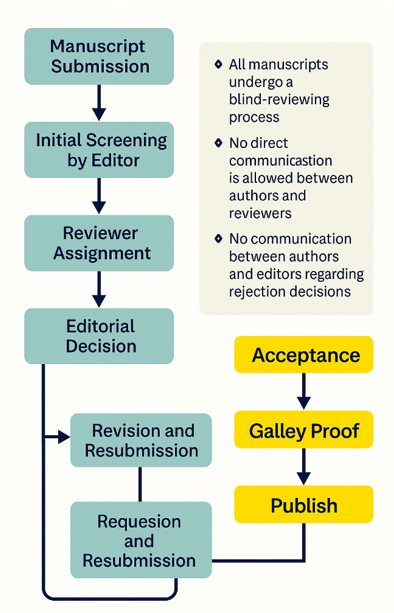
1. Manuscript Submission
Authors must submit their manuscripts via the official online journal management system. Manuscripts submitted via email or outside the system will not be processed.
2. Initial Screening by the Editor
The editor will assess the manuscript based on:
• Alignment with the journal’s focus (educational studies)
• Originality and scientific contribution
• Compliance with the writing guidelines
• Plagiarism check using Turnitin (maximum similarity rate of 20%) Manuscripts that do not meet the minimum standards will be rejected outright (desk reject) by the editor without being sent to reviewers.
3. Assignment of Reviewers
Manuscripts that pass the initial screening will be sent to at least two to three expert reviewers, comprising:
• One internal reviewer from the Indonesia University of Education
• One or more external reviewers from national or international institutions Reviewers are selected based on their field of expertise, publication track record, and freedom from conflicts of interest.
4. Peer Review Process
Reviewers will evaluate the manuscript based on:
• Theoretical relevance and empirical contribution
• Research design and methodology
• Structure, language and clarity of writing
• Implications for educational development
• Compliance with research principles and ethics
Review results are accompanied by recommendations:
• Accepted without revision
• Accepted with minor revisions
• Accepted conditionally with major revisions
• Revise and resubmit (conditional rejection)
• Rejected
Important Note: All submitted manuscripts must undergo a blind peer-review process. Direct communication between authors and reviewers is not permitted whilst the review process is ongoing.
Communication between authors and the editor regarding rejection decisions is not permitted.
All decisions are final and are communicated officially via the journal system.
5. Editorial Decision
The Editorial Board will make the final decision based on the reviewers’ recommendations. The outcome of the decision (accepted, revised, or rejected) will be sent to the author via the journal system.
6. Revisions and Resubmission
If revisions are requested, the author must submit:
• The revised version of the manuscript
• A detailed response to each reviewer’s comment The manuscript may then undergo a second or subsequent round of review until it meets publication standards.
7. Finalisation and Galley Proofs
Once the manuscript has been accepted, a galley proof will be sent to the author for correction and approval.
No major changes are permitted at this stage prior to the article’s official publication.
Editorial Ethics & Appeal Procedures
• Authors are entitled to lodge a single appeal against an editorial decision by presenting strong and valid academic arguments.
• Editors are not permitted to handle manuscripts:
o Written by themselves
o Written by family members or close associates
o Relating to products, services or institutions that give rise to a conflict of interest
Such manuscripts will be assigned to an independent editor.
• The Editor-in-Chief bears ultimate responsibility for ensuring the integrity, objectivity and ethical standards of the entire editorial process.
Publication Frequency
Each volume of Evidence Synthesis in Education comprises two issues per year, published in January and August. Each issue contains five articles, meaning that each volume contains a total of ten scholarly articles. Evidence Synthesis in Education is published electronically via the journal’s official website at: https://ejournal-sps.upi.edu/ese/
This journal is published by the Postgraduate School, Universitas Pendidikan Indonesia.
First published: January 2027
Publication Ethics and Malpractice Statement
In accordance with the recommendations of Elsevier and COPE’s Best Practice Guidelines for Journal Editors, Evidence Synthesis in Education upholds integrity in the scientific publishing process. The publication of articles in this peer-reviewed journal constitutes a lasting contribution to the advancement of knowledge and reflects the quality of the authors’ work and the institutions that support them. Therefore, clear ethical standards are required for all parties involved: authors, editors, reviewers, publishers, and institutional partners. We ensure that revenue from advertising, reprints, or other commercial interests does not influence editorial decisions. The editorial board will also facilitate communication with other journals or publishers where necessary to ensure academic transparency.
Authors’ Responsibilities
1. Reporting Standards
Authors must present research findings accurately and objectively, including methods, data and their significance. Articles must include sufficient references and details to allow for replication. Fabrication or distortion of data constitutes a serious ethical violation.
2. Data Access and Storage
Authors may be required to provide raw data for editorial review purposes, and to store it for a reasonable period following publication.
3. Originality and Plagiarism
Authors must ensure that the manuscript is original. All quotations from other works must be properly attributed. Any form of plagiarism, including paraphrasing without attribution or claiming the research results of others as one’s own, is unacceptable.
4. Duplicate or Redundant
Publication Manuscripts describing the same research results must not be submitted to more than one journal. Simultaneous submission is considered unethical.
5. Acknowledgement of Sources
References that have influenced the research must be cited. Personal information or the results of discussions with third parties must not be included without written permission.
6. Authorship
Only individuals who have made a significant contribution to the design, conduct or interpretation of the study may be listed as authors. All authors must approve the final version and its submission.
7. Conflicts of Interest
Authors are required to disclose potential conflicts of interest (financial, institutional, etc.). All forms of funding support must be disclosed openly.
8. Errors in Publication
If an author discovers a significant error in a published article, they must inform the editor for correction or retraction.
Editorial Responsibilities
1. Publication Decisions
The editor is responsible for the final decision to publish an article based on the validity of its content and its contribution to the scientific field.
2. Fair Assessment
Manuscripts are assessed without discrimination on the basis of race, gender, religion, nationality or political views.
3. Confidentiality
Information relating to submitted manuscripts must only be accessed by authorised parties: the editor, reviewers, and the publisher.
4. Conflicts of Interest
Editors must not use information contained in unpublished manuscripts for personal gain. Editors must recuse themselves from handling a manuscript if a conflict of interest arises.
5. Handling of Ethical Breaches
Editors must take reports of ethical breaches seriously, cooperating with the publisher and relevant institutions to investigate and, where necessary, publish corrections, retractions or supplementary notes.
Responsibilities of Reviewers
1. Contribution to Editorial Decisions
Peer review assists editors in making publication decisions and provides feedback to authors to improve the quality of manuscripts.
2. Timeliness
Reviewers who feel they lack the competence or are unable to complete the review on time must inform the editor and withdraw.
3. Confidentiality
Manuscripts received for review must be kept confidential and must not be shared without the editor’s permission.
4. Objectivity
Reviews must be conducted objectively and professionally, with supporting arguments. Personal criticism of the author is not permitted.
5. Acknowledgement of Sources
Reviewers must inform the editor if any part of the manuscript fails to cite important sources or if there are similarities with other published works.
6. Conflict of Interest
Reviewers must not assess a manuscript if there is a conflict of interest, whether due to professional relationships, institutional affiliations, or financial interests with the author or the research topic.
Plagiarism Screening
The manuscript that submitted into this journal will be screened for plagiarism using Turnitin plagiarism checker. All manuscripts will be checked that they are free from plagiarism practice (less than 15% similarities). If there an indication of plagiarism (higher than 20% similarities), the manuscript will instantly be rejected.
Fees
Evidence Synthesis in Education (ESE) is a fully open access journal. Since its initial publication in 2026, authors are not required to pay any article processing charges (APC) or submission fees. All submitted manuscripts are processed and published free of charge.
Readers are granted free and unrestricted access to read, download, and share the full-text articles published in this journal without any subscription or payment.
Author Guideline
General Writing Guidelines
Article Title
The article title must be concise, specific and accurately reflect the content of the manuscript. Avoid the use of rarely used abbreviations.
Format: Arial 15 pt bold, centred, with 0 pt top spacing and 12 pt bottom spacing.
Author Names and Affiliations
Authors’ names should be written without academic titles or professional titles. Use full names (first name and surname). Affiliations should include: department/unit name, faculty, university, address, and country. The corresponding author must be marked with a superscript asterisk (*) and include an email address.
(i) Author’s name: Arial 11 pt, centred, with 24 pt top spacing.
(ii) Affiliation: Arial 9 pt italic, numbered in superscript according to order.
Abstract and Keywords
The abstract must be written in English and be between 100 and 300 words in length, without quotations or references. It must briefly explain the aim, methods, main findings and contribution of the study. Keywords: a maximum of 5 words/terms, separated by semicolons (;). Avoid uncommon abbreviations.
Introduction
The introduction aims to establish the research context and explicitly demonstrate the scientific contribution. Authors are advised to structure the introduction systematically, covering the following elements:
(i) General Information: Outline the general background of the topic under investigation, its relevance to the field of vocational education, and related global or national issues.
(ii) Problem Definition: Explain the main problem or real-world challenge that forms the focus of the research. Avoid overly general or normative statements state a specific and measurable problem.
(iii) Brief Literature Review (State of the Art): Summarise relevant previous research developments, including theories, approaches or models that have been used. Include at least 5 key citations to demonstrate the current state of knowledge.
(iv) Gap Analysis: Identify the limitations or gaps in previous studies. Highlight what has not yet been done, examined, or successfully addressed, whether in terms of concepts, methods, or implementation.
(v) Research Objectives: Clearly formulate the research objectives or research questions at the end of the introduction. The objectives must refer directly to the gaps identified and provide a specific direction for the research.
Methods
Describe the methods clearly to enable replication. Include any significant modifications to previously published methods (simply cite them). Avoid repeating standard methods.
Results and Discussion
Results should be presented clearly and concisely, distinguished from the findings of previous studies. The discussion should address:
(i) Do the results address the research objectives?
(ii) What is the scientific interpretation?
(iii) Are they consistent with other studies, or are there differences?
Conclusion
The conclusion must refer directly to the research objectives and explain the scientific contribution to the vocational field. Avoid repeating the abstract or experimental results. Include suggestions for further research where relevant.
Acknowledgements
List the names of individuals or organisations that contributed to the research, including funders, supervisors, language editors, data providers, or relevant institutions.
References
(i) Use the vancouver citation style
(ii) A minimum of 10 references, with 80 per cent drawn from publications within the last 10 years
(iii) Primary references must be journal articles, academic books, research reports, theses or dissertations
It is recommended to use reference management software such as Mendeley or EndNote