About the Journal
Aim and Scope
NGT-HD focuses on advancing scholarly inquiry and professional discourse in the fields of teacher education, professional teacher development, and human development. The journal provides a platform for critical engagement and innovation that aligns with the evolving demands of 21st-century education.
The journal welcomes contributions addressing (but not limited to) the following topics:
· Pedagogical innovations in pre-service and in-service teacher education
· Competency-based teacher education curriculum and assessment
· Reflective practice, coaching, and mentoring in teacher preparation
· Inclusive education and differentiated instruction
· Value-based education, character and moral education in teacher training
· Digital pedagogy, learning technologies, and blended learning in teacher education
· Educational leadership and teacher leadership development
· Teacher identity, agency, and professionalism
· International perspectives and comparative studies on teacher education
· Policy and reform in professional teacher development
Methodological Openness
NGT-HD embraces a wide range of methodological approaches that reflect the complex, multidimensional nature of teacher education and human development. The journal values methodological diversity and encourages authors to select designs that best capture the depth and context of their inquiries.
The journal accepts submissions based on the following methodological approaches:
· Quantitative research, including experimental, quasi-experimental, and correlational designs that use statistical analysis to examine variables related to teacher education and professional development.
· Qualitative research, such as case studies, ethnography, narrative inquiry, phenomenology, grounded theory, and discourse analysis that provide rich contextual insights into teaching practices, learning processes, identity formation, and professional reflection.
· Mixed-methods research that combines quantitative and qualitative techniques to explore teacher education phenomena holistically.
· Participatory and action research, especially in the form of collaborative inquiry among educators, aimed at transforming practice and promoting professional learning.
· Systematic literature reviews and meta-analyses that critically synthesize current knowledge, identify gaps, and offer conceptual advancement.
· Theoretical and conceptual papers that propose new frameworks, models, or critical perspectives relevant to teacher education and human development.
· Policy analysis examining the impact, challenges, and effectiveness of educational policies on teacher training systems and professional standards.
Regardless of approach, all submitted manuscripts must demonstrate:
· A clear research objective or problem
· Conceptual or theoretical grounding
· Methodological rigor and ethical research practice
· Relevance and contribution to the field of teacher education and human development
Through this openness, NGT-HD aims to foster a dynamic and inclusive scholarly conversation that bridges academic theory, practitioner insight, and policy relevance in the formation of new-generation teachers.
Target Audience
NGT-HD is intended for a broad range of stakeholders engaged in teacher education and human development. The journal seeks to reach:
· Teacher educators and lecturers in higher education institutions who are responsible for the design, implementation, and evaluation of teacher preparation programs.
· Pre-service and in-service teacher trainers seeking to apply evidence-based practices and innovations in pedagogy, curriculum, and assessment.
· School leaders and education supervisors interested in the professional development and instructional leadership of teachers.
· Researchers and postgraduate students working in the fields of education, human development, learning sciences, and teacher professionalism.
· Education policymakers and curriculum developers involved in formulating teacher education frameworks, standards, and reforms at national or regional levels.
· Non-governmental organizations (NGOs) and international development agencies that focus on capacity-building, inclusive education, and the sustainable development of the teaching profession.
· Think tanks and professional associations interested in promoting ethical leadership, character education, and intercultural competencies among new-generation teachers.
With its interdisciplinary and practice-oriented focus, NGT-HD aims to bridge the gap between theory, policy, and classroom realities to contribute to the transformation of teacher education systems and human development initiatives globally.
Peer Review Process
Manuscripts submitted to NGT-HD, published by the Graduate School of Universitas Pendidikan Indonesia, must undergo a peer review process (blind-reviewing process) to be considered for publication. All submitted manuscripts will first be screened by the editors to evaluate their content relevance, scope, and novelty. Manuscripts that pass this initial screening will proceed to the peer review stage.
To ensure a fair and objective evaluation, each manuscript will be reviewed by a minimum of three reviewers, consisting of:
- 1 internal reviewer (from Universitas Pendidikan Indonesia), and
- 2 external reviewers (from other national or international institutions).
Direct communication between authors and reviewers is strictly prohibited during the review process. Furthermore, rejection decisions are final and cannot be negotiated through direct correspondence with the editor.
Authors will receive an official notification through the journal’s system regarding the status of their manuscript (accepted, revision requested, or rejected), based on the reviewers’ evaluations. This journal employs a double-anonymized peer review process, in which the identities of both authors and reviewers are concealed to ensure objective assessment.
Editorial and Peer Review Workflow
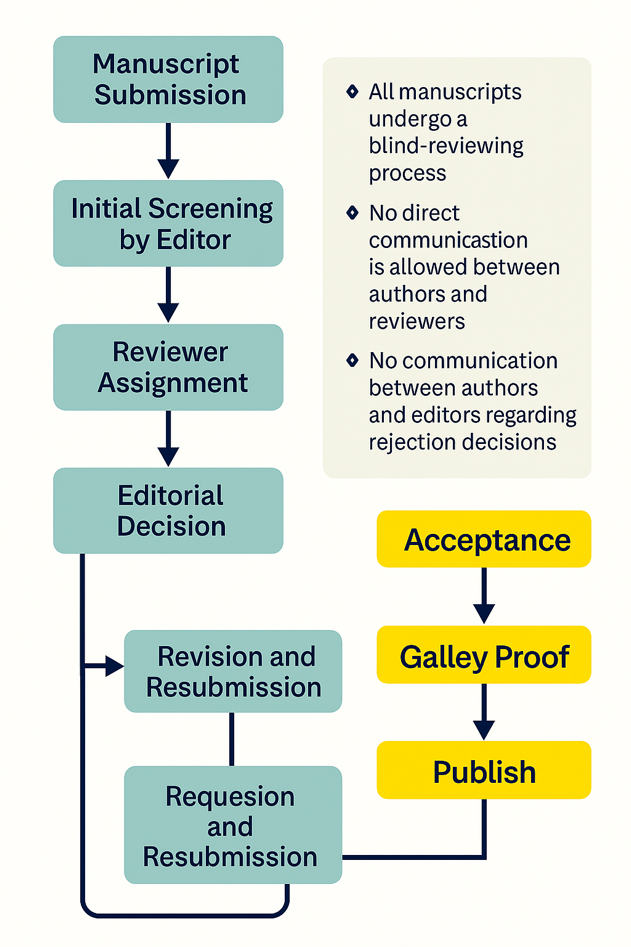
1. Manuscript Submission
Authors are required to submit their manuscripts through the official online journal management system. Manuscripts submitted via email or outside the system will not be processed.
2. Initial Editorial Screening
The editor will assess the manuscript based on the following criteria:
(i) Relevance to the journal's scope (vocational behavior, vocational pedagogy, and career development)
(ii) Novelty and scholarly contribution
(iii) Compliance with author guidelines
(iv) Plagiarism screening using Turnitin (maximum similarity index: 20%)
Manuscripts that do not meet these minimum standards may be desk rejected without being forwarded for peer review.
3. Reviewer Assignment
Manuscripts that pass the initial screening will be assigned to a minimum of two to three expert reviewers, consisting of:
(i) One internal reviewer from Universitas Pendidikan Indonesia
(ii) One or more external reviewers from other national or international institutions
Reviewers are selected based on subject expertise, publication record, and absence of conflict of interest.
4. Peer Review Process
Reviewers will evaluate manuscripts based on:
(i) Theoretical relevance and empirical contribution
(ii) Research design and methodology
(iii) Structure, language, and clarity of writing
(iv) Implications for vocational pedagogy and career development
(v) Adherence to research ethics and integrity
Reviewer recommendations may include:
(i) Accepted without revision
(ii) Accepted with minor revisions
(iii) Conditionally accepted (major revisions required)
(iv) Revise and resubmit (conditional rejection)
(v) Rejected
Important Notes:
(i) All submitted manuscripts must undergo a blind peer review process.
(ii) Direct communication between authors and reviewers is strictly prohibited during the review process.
(iii) Communication regarding rejection decisions is not permitted between authors and editors. All decisions are final and will be communicated officially via the journal system.
5. Editorial Decision
The editorial board will make the final decision based on reviewer feedback. The decision (accepted, revision requested, or rejected) will be sent to the author through the journal system.
6. Revision and Resubmission
If revisions are required, authors must submit:
(i) A revised version of the manuscript
(ii) A detailed response to each reviewer comment
The manuscript may undergo a second or more rounds of peer review until it meets the journal’s publication standards.
7. Finalization and Galley Proof
Once the manuscript is accepted, the galley proof will be sent to the author for correction and approval. No major changes are allowed at this stage before the article is officially published.
Editorial Ethics & Appeal Procedure
1. Authors are entitled to submit one appeal against an editorial decision by providing a strong and valid academic justification.
2. Editors are prohibited from handling manuscripts if:
(i) They are the author of the manuscript
(ii) The manuscript is authored by a family member or close colleague
(iii) The manuscript is related to a product, service, or institution in which the editor has a conflict of interest
3. In such cases, the manuscript will be reassigned to an independent editor.
4. The Editor-in-Chief holds final responsibility for ensuring the integrity, objectivity, and ethical conduct of the entire editorial process.
Publication Frequency
Each volume of NGT-HD is published in two issues per year, in June and December Each issue contains 5 articles, making a total of 10 scholarly articles per volume.
NGT-HD is published electronically via the official journal website at:
https://ejournal-sps.upi.edu/ngt-hd
This journal is published by the School of Postgraduate Studies of Universitas Pendidikan Indonesia, under theTeacher Professional Education Program, which focuses on the teacher professional education and its contribution to human development across diverse cultural and institutional contexts.
Commencement of publication: June 2026
Publication Ethics and Malpractice Statement
In accordance with the recommendations of Elsevier and the COPE Best Practice Guidelines for Journal Editors, NGT-HD upholds the highest standards of integrity in academic publishing. The publication of articles in this peer-reviewed journal constitutes a significant contribution to the advancement of knowledge and reflects the quality of the authors' work and the institutions supporting them. Therefore, clear ethical standards are required for all parties involved in the publishing process: authors, editors, reviewers, publishers, and affiliated institutions.
We ensure that advertising, reprints, or commercial interests have no influence on editorial decisions. The editorial board will also assist in ethical communication with other journals or publishers when necessary to ensure academic transparency.
Authors’ Responsibilities
- Reporting Standards
Authors must present their research accurately and objectively, including the methodology, data, and significance of the findings. Articles must include sufficient detail and references to allow replication. Falsification or distortion of data is a serious ethical violation.
- Data Access and Retention
Authors may be asked to provide raw data for editorial review and are expected to retain such data for a reasonable period after publication.
- Originality and Plagiarism
Manuscripts must be original. All quotations or references to the work of others must be properly cited. All forms of plagiarism—including paraphrasing without attribution or claiming the results of others—are unacceptable.
- Multiple or Redundant Publication
Manuscripts that describe essentially the same research should not be submitted to more than one journal. Simultaneous submission is considered unethical.
- Acknowledgment of Sources
All sources that have significantly influenced the research must be cited. Personal communications or discussions with third parties may not be included without written permission.
- Authorship
Only individuals who made substantial contributions to the research design, execution, or interpretation may be listed as authors. All listed authors must approve the final version and agree to its submission.
- Conflicts of Interest
Authors must disclose any potential conflicts of interest—financial, institutional, or otherwise. All sources of research funding must be clearly acknowledged.
- Fundamental Errors in Published Work
If authors discover a major error or inaccuracy in their published article, they are obliged to inform the editor promptly for correction or retraction.
Editors’ Responsibilities
- Publication Decisions
Editors are responsible for deciding which articles will be published, based on the manuscript's academic merit and relevance to the field.
- Fair Evaluation
Manuscripts are evaluated based solely on their intellectual content, without discrimination based on race, gender, belief, nationality, or political views.
- Confidentiality
The editor and editorial staff must maintain confidentiality regarding all submitted manuscripts, sharing information only with those directly involved in the editorial process.
- Conflicts of Interest
Editors must not use unpublished material from a submitted manuscript for personal research without the author's consent. If a conflict of interest exists, editors must recuse themselves from handling the manuscript.
- Handling Ethical Violations
Editors must respond seriously to allegations of ethical misconduct, collaborating with the publisher and relevant institutions to investigate and, if necessary, publish corrections, retractions, or statements of concern.
Reviewers’ Responsibilities
- Contribution to Editorial Decisions
Peer review supports editorial decision-making and helps authors improve the quality of their manuscripts.
- Promptness
Reviewers who feel unqualified or are unable to review in a timely manner must inform the editor and withdraw from the process. - Confidentiality
Manuscripts under review must be treated as confidential and may not be shared without the editor’s permission. - Objectivity
Reviews must be conducted professionally and objectively. Personal criticism of authors is not acceptable. - Acknowledgment of Sources
Reviewers should inform editors of relevant, uncited works or substantial similarities to other published papers.
- Conflicts of Interest
Reviewers must not evaluate manuscripts where there is a conflict of interest—whether personal, institutional, or financial—with the authors or the research content.
Plagiarism Screening
The manuscript that submitted into this journal will be screened for plagiarism using Turnitin plagiarism checker. All manuscripts will be checked that they are free from plagiarism practice (less than 20% similarities). If there an indication of plagiarism (higher than 20% similarities), the manuscript will instantly be rejected.
Fees
NGT-HD: New Generation Teachers and Human Development is a fully open access journal. Since its initial publication in 2026, authors are not required to pay any article processing charges (APC) or submission fees. All submitted manuscripts are processed and published free of charge.
Readers are granted free and unrestricted access to read, download, and share the full-text articles published in this journal without any subscription or payment.
Author Guideline
General Manuscript Guidelines
Article Title
The title should be concise, specific, and accurately reflect the content of the manuscript. Avoid using rarely-used abbreviations.
Format: Times New Roman 15 pt bold, center-aligned, with 0 pt spacing above and 12 pt below.
Author Name(s) and Affiliation(s)
Author names should be written without academic titles or professional positions. Use full names (first and last names). Affiliation must include: department/unit, faculty, university, address, and country. The corresponding author should be marked with a superscript asterisk (*) and must provide an email address.
· Author name: Times New Roman MT 12 pt, center-aligned, with 24 pt spacing above.
· Affiliation: Times New Roman MT 9 pt italic, with superscript numbers to indicate affiliations.
Abstract and Keywords
The abstract must be written in English, ranging from 100–300 words, and should not include citations or references. It should concisely state the objective, methodology, key findings, and the contribution of the study.
Keywords: Maximum of 5 keywords or key phrases, separated by semicolons (;). Avoid uncommon abbreviations.
Introduction
The introduction should establish the context of the research and clearly highlight the scientific contribution. Authors are encouraged to structure the introduction systematically, covering the following components:
1. General Information: Present general background on the topic, its relevance in vocational education, and related national or global issues.
2. Problem Definition: Define the central issue or challenge addressed. Avoid general or normative statements—articulate a specific, measurable research problem.
3. State of the Art: Briefly review relevant prior studies, including theories, models, or methods. Include at least 5 key citations to show the current knowledge landscape.
4. Gap Analysis: Identify gaps or limitations in existing research—what remains unaddressed or unresolved, either conceptually, methodologically, or in application.
5. Research Objective: Clearly state the research objective or question at the end of the introduction. It should directly respond to the gap identified and provide a clear research direction.
Methods
Provide a clear and detailed description of the research methodology so the study can be replicated. If previously established methods are used, cite them appropriately and describe only significant modifications. Avoid repeating standard procedures in detail.
Findings and Discussion
Results should be presented clearly and concisely, and compared with findings from previous studies.
The discussion should address:
1. Do the results answer the research question or objective?
2. What is the scientific interpretation of the findings?
3. Are the results consistent with or different from previous studies?
Conclusion
Conclusions must directly relate to the research objectives and explain the study’s contribution to vocational education. Avoid repeating content from the abstract or results. Include suggestions for future research if applicable.
Acknowledgements
Mention individuals or institutions that contributed to the research, including funders, advisors, language editors, data providers, or supporting organizations.
References
1. Use the Vancouver citation style
2. Include a minimum of 10 references, with at least 80% from publications within the last 10 years
3. Primary sources should include journal articles, academic books, research reports, theses, or dissertations
4. Use reference management software such as Mendeley or EndNote for consistency and formatting accuracy
Vancouver Style Guide: https://dal.ca.libguides.com/CitationStyleGuide/Vancouver